
High-Profile vs. Low-Profile Blades: Does the choice change the result?

When I first started in histology and learned to section tissue, my lab used high-profile blades exclusively. I used them for both routine microtomy and frozen sections until I moved to a new lab that used only low-profile blades for microtomy. At first, I struggled to get a good ribbon, but after some practice, I was able to section all tissue types just as easily as I had with high-profile blades.
That experience made me wonder: how different are these two blade types, and can they produce the same results?
What are the differences?
The main differences between high-profile and low-profile microtome blades are their height, thickness, and overall rigidity. High-profile blades are taller, thicker, and more rigid, while low-profile blades are shorter, thinner, and more flexible.
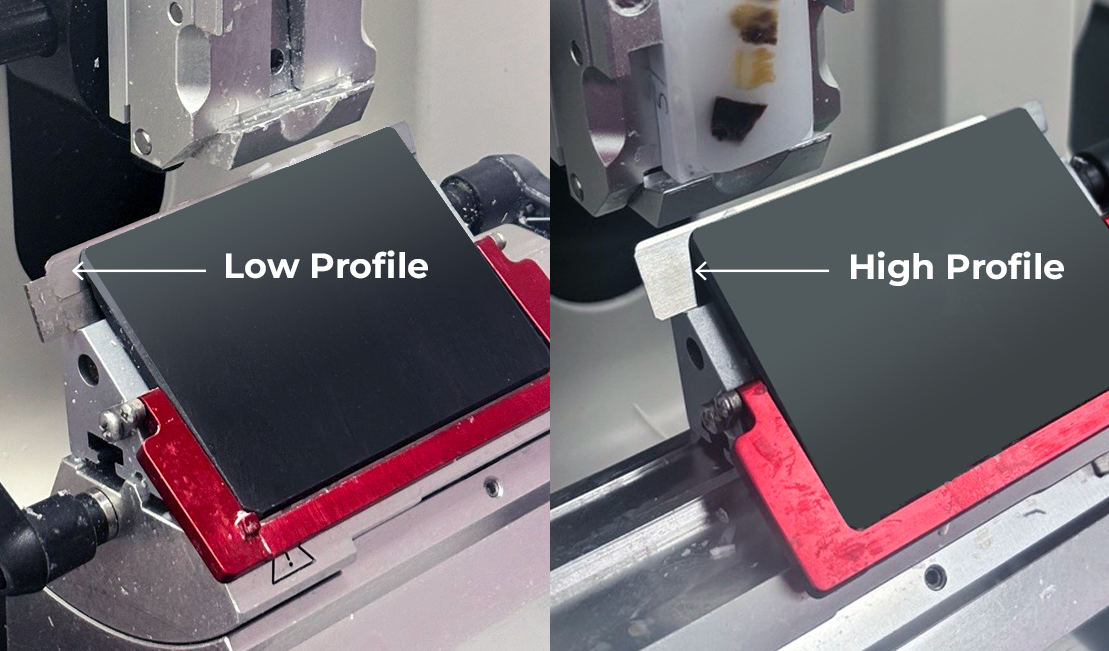
As a general rule of thumb, low-profile blades are often preferred for precision and finesse, making them a popular choice for routine microtomy and delicate biopsies. High-profile blades offer greater stability and durability, which can be beneficial when sectioning more challenging tissues that are dense or fibrous like skin, uterus, or bone, as well as frozen sections.
However, the choice isn’t always that straightforward. In many labs, it depends on the microtome being used – not all are designed to accommodate both blade profiles. Some microtomes, such as the Galileo, offer compatibility with both high and low-profile blades. In other labs, the choice often comes down to user preference. Some histotechs strongly prefer one over the other, while others switch between profiles depending on the tissue being sectioned.
Can you still get the same result?
In many cases, yes.
With proper technique, a well-maintained microtome, and appropriately processed tissue, both blades can produce excellent sections. There may be a learning curve when switching from one to the other, as cutting will feel a little different at first. However, most histotechs can adapt quickly and achieve comparable results with either blade.
Certain specimens may benefit from one blade profile over the other. Ultimately, the “best” blade is often the one that works best for you.
The chart below summarizes the common characteristics of high-profile and low-profile blades.
|
Characteristic |
Low-Profile |
High-Profile |
|
Blade Height |
~8 mm |
~14 mm |
|
Blade Thickness |
Typically thicker |
Typically thinner |
|
Rigidity |
More flexible |
More rigid |
|
Sectioning Feel |
Smooth, fine control |
Stable, durable cutting |
|
Best Application |
Routine paraffin sectioning |
Hard, dense, or challenging tissues |
|
Common Tissue Types |
Most surgical pathology sections |
Skin, uterus, fibrous tissue, decalcified tissue, frozens |
|
Performance on soft/delicate tissue |
Excellent for delicate ribbons |
Good, but may require adjustment of cutting angle |
|
Performance on hard tissue |
May exhibit chatter or vibration |
Better resistance to chatter |
|
Blade Life |
May dull more quickly |
Often lasts longer |
|
Microtome Compatibility |
Requires low-profile holder or adapter |
Requires high-profile holder or adapter |
|
Cryostat Use |
Less common |
Frequently preferred |
Recent Posts
-

StatClick Prefill Handling and Closure
How to properly handle and close the StatClick Prefill for leak-proof transport. Follow your facili
-

Silver stains start here: clean glassware.
We’ve all had that glassware that looks clean—but silver stains can tell a different story. Tiny tra
-
Color Matters: 10 tips for getting the most from Tissue Marking Dyes.
Tissue Marking Dyes may seem like a simple part of the grossing workflow, but small handling habits