
Optimal agitation for effective reagent exchange in tissue processing: Preserving architecture and molecular integrity.
Background
High-quality histologic and molecular outcomes begin with optimal tissue processing. While fixation chemistry and reagent quality receive substantial attention, the physical dynamics of reagent exchange—particularly agitation—are also critical. Inadequate agitation can create reagent gradients and inconsistent
processing, while overly aggressive agitation can mechanically damage fragile specimens.
This paper reviews the importance of controlled agitation in tissue processors, compares common agitation methods, and highlights how gentle bubbling systems—such as those implemented in the Diapath Donatello Series 3—can promote uniform reagent exchange without introducing unnecessary mechanical stress on tissue. This emphasizes that agitation is foundational to preserving tissue morphology, antigenicity, nucleic acid integrity, and ultimately, diagnostic consistency.
The Physics Behind Tissue Processing
Tissue processing is fundamentally a mass transfer problem. The replacement of water with graded alcohols, clearing agents, and paraffin rely on diffusion and convection to ensure complete reagent exchange
within the tissue matrix.
Essentially, tissue processing is a series of diffusion dependent steps, where incomplete exchange leads to poor paraffin infiltration, microtomy artifacts, and compromised morphology. A study by Meier et al. reveals that defective specimens resulting from inadequate tissue processing are identifiable with a value of error of about 4-10%.¹ This is strictly related to errors in the diagnosis and potential negative impact on patient health management and therapy.²
From a transport perspective, diffusion alone is slow, particularly in larger or dense specimens. Convective flow improves exchange, reducing boundary layer thickness at the tissue surface. And uniform agitation prevents concentration gradients within the retort. Thus, agitation is not optional, it is essential.
Consequences of Insufficient Agitation
Reagent Gradients in the Retort Systems that rely on impellers located at the bottom of the retort can generate uneven mixing. When agitation is localized, flow velocity diminishes with distance.
Upper cassette layers may experience slower reagent turnover. And density differences between reagents (e.g., formalin vs. alcohol vs. clearing agents) can exacerbate stratification.
This leads to reagent gradients, where concentrations differ at various levels of the chamber. The result can be inconsistent dehydration across cassettes, under processed tissue in upper regions, variable paraffin infiltration, increased microtomy artifacts such as chatter and compression.³
For example, Figure 1 illustrates the possible generation of closed circulation rings, which does not permit a mixing of the fluid, leading to the generation gradients and inhomogeneous tissue processing. The importance of consistent fixation and processing for maintaining tissue morphology and antigen preservation has been well-established, and pre-analytic variables significantly affect histologic and molecular quality and consistency.
Impact on Molecular Preservation
For molecular diagnostics, uneven processing can compromise DNA integrity, RNA quality, and protein antigenicity for immunohistochemistry. Studies have shown that pre-analytic variables, including fixation and processing parameters directly influence downstream molecular performance.⁴
If reagent exchange is incomplete in certain tissue zones, residual water or improper clearing can inhibit paraffin infiltration, increase oxidative damage, and compromise nucleic acid extraction efficiency. Insufficient agitation is therefore not just a morphology issue, it is a molecular risk factor.
Figure 1. Generation of Closed Circulation Rings
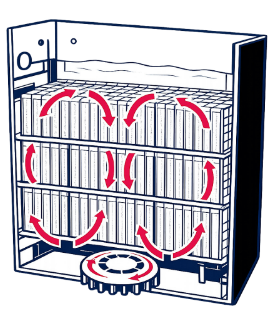
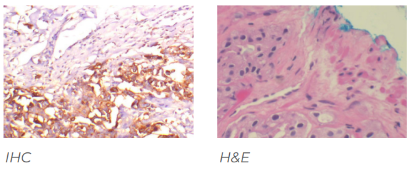
Image 1. Example of Underfixed Tissues
Risks of Excessive Agitation
At the opposite extreme, overly aggressive agitation mechanisms can introduce mechanical forces that can damage fragile specimens.
Mechanical Stress and Tissue Loss
Rotational systems can subject tissue cassettes to acceleration and deceleration forces, shear stress from bulk fluid movement, and cassette-to-cassette impact. While robust tissues may tolerate such forces, delicate specimens such as small biopsies, curettings, fatty breast tissue, and necrotic tumor samples may be susceptible to fragmentation. Loss of friable tissue fragments during processing represents a catastrophic event, particularly when dealing with small core biopsies, limited oncology samples, or research specimens.
Mechanical disruption can also distort architecture, complicating interpretation and potentially impacting staging or margin assessment.
Gentle Bubbling: A Balanced Agitation Approach
An alternative agitation method involves controlled reagent bubbling to induce turbulent, convective flow throughout the retort. Systems such as the Diapath Donatello Series 3 utilize bubbling mechanisms designed to promote even vertical mixing, minimal mechanical stress, and reduced reagent stratification.⁵
Mechanism of Action
Bubbling introduces distributed convection. Gas bubbles rise through the reagent column. Turbulent, vertical flow patterns reduce boundary layers around tissue surfaces, and uniform circulation minimizes concentration gradients. Turbulent flow has been shown to significantly promote mixing processes within a fluid.
In contrast to laminar flow, in which the fluid moves in orderly, parallel layers that do not mix, turbulence
is characterized by vortices, chaotic fluctuations, and movements perpendicular to the main direction of flow.
In particular, turbulent vortices facilitate the transportation of fluid particles, heat or chemicals on macroscopic scales, thereby rendering the mixing process significantly more rapid and effective in comparison to molecular diffusion alone.
In addition, the phenomenon of turbulence, induced by continuous mixing, has been demonstrated to promote enhanced heat transfer and accelerate temperature homogenization.
The analogy between heat and mass transfer indicates that, as turbulence promotes temperature homogenization, it will also allow concentration homogenization to occur rapidly.
This process therefore results in the removal of potential gradients, leading to a state where the reagents are homogeneous and exhibit uniform composition throughout the processing chamber. The presence
of turbulence and vorticity suggests that adequate mixing is occurring. The chaotic motion characteristic
of bubbling agitation results in uniform mixing, without creating any preferential fluid flow patterns.
Unlike bottom impellers, the flow is not localized, and unlike rotational systems, the tissue cassettes remain
stationary.
Advantages
- Reduced Reagent Gradients: Even, vertical mixing promotes uniform dehydration and clearing across all cassette levels.
- Enhanced Reagent Exchange: Convective currents improve mass transfer without relying solely on diffusion.
- Minimal Mechanical Stress: Tissues are not subjected to rotational inertia or collision forces.
- Improved Preservation of Architecture: Gentle agitation protects fragile structures such as necrotic tumor cores, adipose-rich samples, and small biopsy fragments.
Figure 2. Fluid Velocity in Tissue Processor Retort
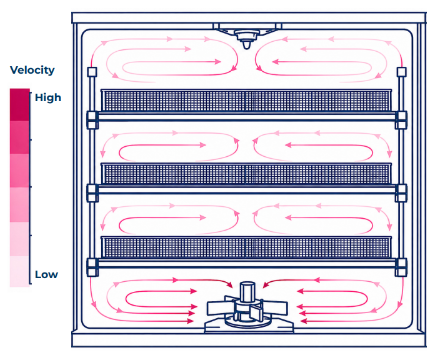
Low velocities in upper and peripheral regions due to smaller impeller limit effective solution exchange, resulting in poor fluid agitation.
Figure 3. Bubbling vs Impeller Agitation Systems 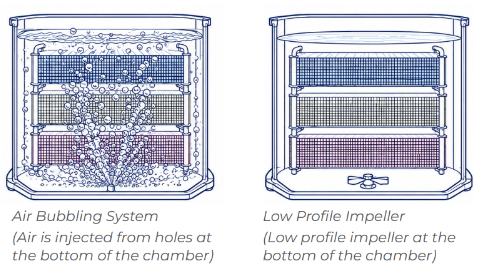
Figure 4. Bubbling vs Impeller CFD Simulation
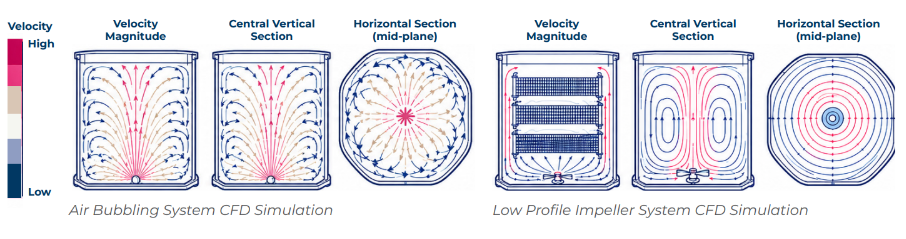
Table 1. Bubbling vs Impeller Features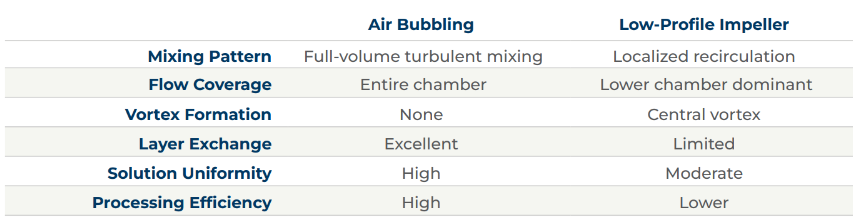
Potential Clinical and Diagnostic Implications
Agitation impacts staining quality, immunohistochemical reproducibility, in situ hybridization performance, and DNA/RNA preservation for molecular analyses. Because tissue samples now must support both morphologic diagnosis and complex molecular testing, suboptimal reagent exchange is no longer acceptable.
Tissue diagnostic results depend on:
- Complete and proper fixation
- Consistent dehydration
- Complete clearing
- Uniform paraffin infiltration
- Preservation of morphology and molecular content
Agitation methods directly influence each of these steps.
Conclusion
Effective tissue processing is not merely a function of reagent chemistry. It is fundamentally dependent on mass transfer dynamics.
Too little agitation can lead to reagent gradients and inconsistent processing across retort levels. Too aggressive agitation can introduce mechanical stress that can damage or destroy fragile specimens. Balanced, gentle agitation, such as bubbling-based systems exemplified by the Diapath Donatello Series 3, promotes uniform reagent exchange while protecting delicate tissues.
In modern pathology, where precious patient samples must support increasingly sophisticated downstream diagnostic techniques, proper reagent exchange is crucial. Optimal agitation ensures superior morphology, reliable immunohistochemistry, nucleic acid preservation, and reproducible diagnostic outcomes.
Ultimately, the goal of tissue processing is simple yet profound: preserve the patient’s tissue as faithfully as possible. Proper agitation is a critical and often underappreciated determinant of achieving that goal.
References
1. Rao, S., Masilamani, S., Sundaram, S., Duvuru, P., & Swaminathan, R. (2016). Quality Measures in Pre-Analytical Phase of Tissue
Processing: Understanding Its Value in Histopathology. Journal of clinical and diagnostic research : JCDR, 10(1), EC07–EC11. https://doi.org/10.7860/
JCDR/2016/14546.7087
2. Woods, A.E. & Ellis, R.C. (eds.) 1994. Laboratory Histopathology: A Complete Reference. Edinburgh: Churchill Livingstone.
3. Lerch ML, Bauer DR, Theiss A, Chafin D, Otter M, Baird GS. Monitoring Dehydration and Clearing in Tissue Processing for High-Quality Clinical
Pathology. Biopreserv Biobank. 2019;17(4):303-311. doi:10.1089/bio.2018.0122
4. Agrawal L, Engel KB, Greytak SR, Moore HM. Understanding preanalytical variables and their effects on clinical biomarkers of oncology and
immunotherapy. Semin Cancer Biol. 2018;52(Pt 2):26-38. doi:10.1016/j.semcancer.2017.12.008
5. Frédéric Risso. Agitation, Mixing, and Transfers Induced by Bubbles. Annual Review of Fluid Mechanics, 2018, vol. 50, pp. 25-48. ⟨10.1146/annurev
fluid-122316-045003⟩. ⟨hal-01778999
Recent Posts
-

Behind Every Breast Cancer Diagnosis
During Breast Cancer Awareness Month in October, we recognize patients and families, along with the
-

HT or HTL? Which path is right for you?
You like histology. You’ve been working in the lab, and now you’re starting to think about getting c
-
StatClick Prefill Handling and Closure
How to properly handle and close the StatClick Prefill for leak-proof transport. Follow your facili