
Assessing cassettes during decalcification.
PiSmart Cassettes deliver outstanding performance across harsh decalcification.
Background
Labeling and tracking of patient samples throughout the histology workflow is one of the most important steps in getting accurate results to patients, ensuring patient safety. Cassette printers have been increasingly used to help avoid errors and reduce workloads. Due to their high resolution and lower maintenance requirements, Infrared (IR) laser printers have become increasingly popular in recent years, especially for high volume laboratories. However, one downside of this technology is performance of laser additive cassettes through the harsh acidic conditions of decalcification solutions. The heavy metals present in these cassettes tend to interact with the acid causing fading and sometimes loss of readability and scanability can result.
Labeling and tracking of patient samples throughout the histology workflow is one of the most important steps in getting accurate results to patients, ensuring patient safety. Cassette printers have been increasingly used to help avoid errors and reduce workloads. Due to their high resolution and lower maintenance requirements, Infrared (IR) laser printers have become increasingly popular in recent years, especially for high volume laboratories. However, one downside of this technology is performance of laser additive cassettes through the harsh acidic conditions of decalcification solutions. The heavy metals present in these cassettes tend to interact with the acid causing fading and sometimes loss of readability and scanability can result.
Method
PiSmart cassettes (CAS-LPI100SL-WH) were tested in nine commonly used decalcification solutions (Table 1). Strong decalcification solutions (containing hydrochloric or nitric acid) and weak decalcification solutions (containing formic acid or EDTA) were assessed. Cassettes were tested both to understand performance change over time and how they compared to Slimline (0103-3133-16) and competitor laser cassettes.
PiSmart cassettes (CAS-LPI100SL-WH) were tested in nine commonly used decalcification solutions (Table 1). Strong decalcification solutions (containing hydrochloric or nitric acid) and weak decalcification solutions (containing formic acid or EDTA) were assessed. Cassettes were tested both to understand performance change over time and how they compared to Slimline (0103-3133-16) and competitor laser cassettes.
Table 1.
Decalcifiers and grades tested.
Decalcifiers and grades tested.

Results
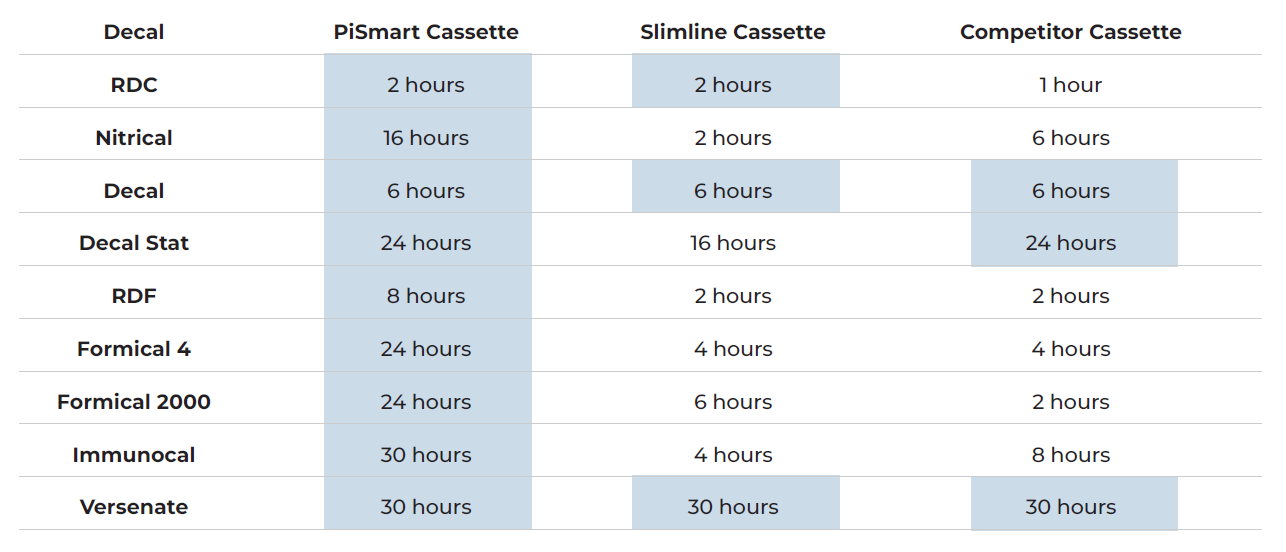
Across nearly all decalcification solutions, the PiSmart cassettes outperformed the Slimline and Competitor laser cassettes.Table 2.
Time at start of scanning performance failure on PiSmart printer. Best results highlighted in blue.
Across nearly all decalcification solutions, the PiSmart cassettes outperformed the Slimline and Competitor laser cassettes.Table 2.
Time at start of scanning performance failure on PiSmart printer. Best results highlighted in blue.

Conclusion
StatLab PiSmart laser cassettes offer exceptional performance across commonly used decalcification solutions. Our PiSmart laser customers can feel confident in the performance of these cassettes as part of the PiSmart printer ecosystem.
StatLab PiSmart laser cassettes offer exceptional performance across commonly used decalcification solutions. Our PiSmart laser customers can feel confident in the performance of these cassettes as part of the PiSmart printer ecosystem.
Recent Posts
-
StatClick Prefill Handling and Closure
How to properly handle and close the StatClick Prefill for leak-proof transport. Follow your facili
-
Silver stains start here: clean glassware.
We’ve all had that glassware that looks clean—but silver stains can tell a different story. Tiny tra
-
Color Matters: 10 tips for getting the most from Tissue Marking Dyes.
Tissue Marking Dyes may seem like a simple part of the grossing workflow, but small handling habits