
Hold that tissue! Why your tissue sections stick (or don’t).
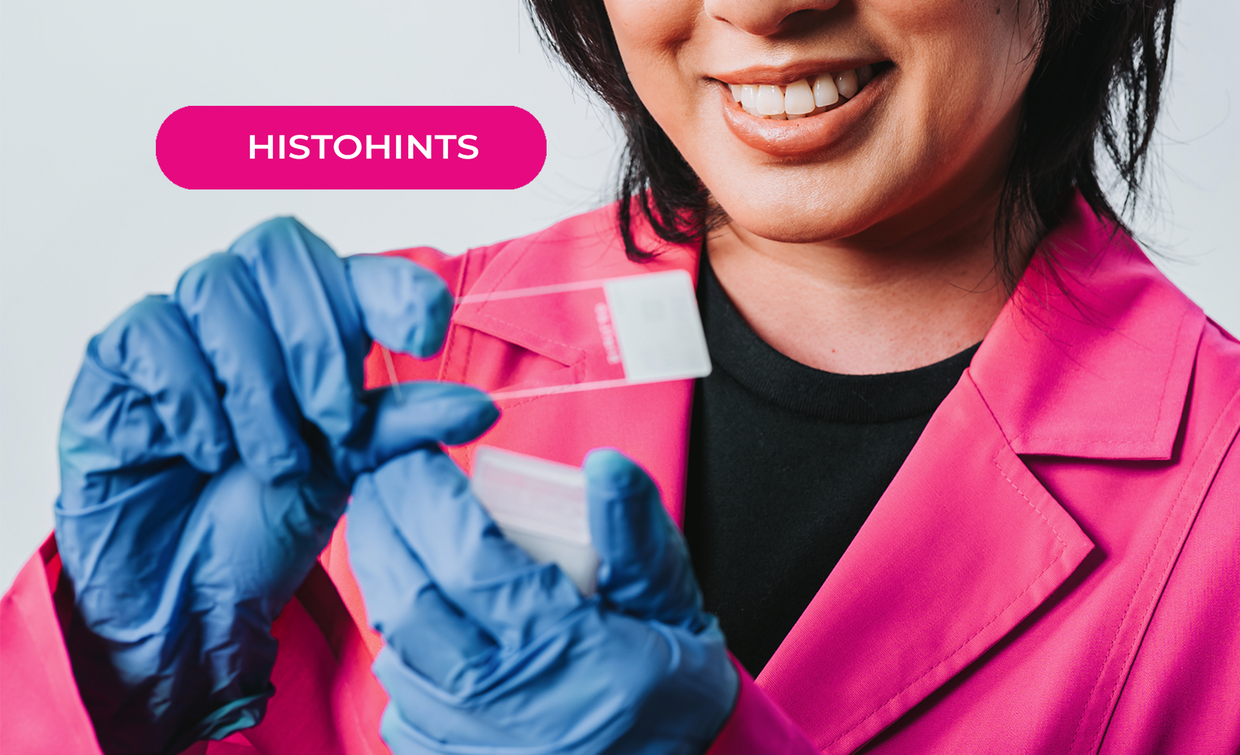
Have you ever wondered how tissue sections stay perfectly in place on a microscope slide through all the heating, staining, and rinsing steps? Or how sometimes a tissue section floats off the slide mid-stain or vanishes during antigen retrieval? If you've been in histology long enough, you know this frustration. The good news? It's often not your technique, it's the slide. Let's explore adhesion slides and why they matter more than you might think.
What is an adhesion slide?
You’ve probably heard terms like charged, positive, plus, coated, or adhesion slides. While they sound different, they all refer to the same concept – slides that help tissue sections stick better throughout staining. They feature a surface treatment (coating) with an electrical charge that attracts tissue components for better adhesion. Coatings used are typically poly-L-lysine, silane, or proprietary polymers to create a physical layer that enhances tissue adherence.
What’s the difference between coatings?
Not all coatings perform the same. Here’s a quick breakdown:
- Poly-L-lysine: Creates a sticky surface using a synthetic amino acid. Good for general use but may not hold up well under heat or harsh chemicals. Often used for cytology slides.
- Silane: Forms covalent bonds with tissue, offering stronger adhesion. It can be a good choice for IHC.
- Proprietary coatings: These can vary by manufacturer and are optimized for specific applications. Some may offer stronger adhesion, reduced background staining, and will have different waterbath behaviors: tissue jumps to the slide (hydrophobic) or is chased by the slide (hydrophilic). Check out this Waterbath HistoHints for helpful tips.
Are some slides stronger than others?
Absolutely! Not all adhesion slides perform the same. Factors like coating type, manufacturing quality, and surface uniformity can all affect how well a slide holds on to tissue. Adhesion slides like KT3+ have a hydrophobic surface, making them ideal for leveled biopsies. They perform well for routine H&Es or special stains, some IHC, and frozen sections. Other adhesion slides like KT5+ have a more hydrophilic surface, designed for trickier tissues like breast and skin, and can withstand the harsh conditions of IHC. KT5+ slides also exhibit little to no background staining–even with silver stains–and are an excellent choice for digital pathology. While excessive slide background may not affect tissue staining, it could be cause for an unacceptable slide for digital pathology, increasing the scan time and image file size, resulting in extra time and costs.
How to pick the right slide for your lab.
Don’t hesitate to sample different slides to find the best fit for your workflow. Ask yourself:
- What types of tissues are you working with?
- Are you performing IHC, special stains, or frozen sections?
- Does your lab use digital pathology?
- Do you prefer one slide for all applications or different slides for specific needs?
Choosing the right slide can save time, reduce errors, and improve patient care. As a histotech, you know that every step in the process matters. Don’t let your slides be the weak link. Understanding the differences between adhesion slide types helps you troubleshoot issues and keep your workflow smooth.
Next time a section lifts, don’t just blame the stain – check the slide.
Discover the data behind adhesion slides with these studies and white papers:
- White Paper: Are your slides sticky enough for tricky tissues?
- NSH Scientific Poster: Assessing Adhesion Slide Performance Study
Not sure what slide to choose for your applications?
Recent Posts
-

Amyloid Sections Washing Off? Let’s get to the bottom of this tricky stain.
Have you ever wondered how an 8–10 µm amyloid section washes off with aggressive alkaline rinses of
-

Thinking of going xylene-free? Here’s what labs should know.
Histotechs know the dangers and health risks associated with xylene, and interest in greener labs co
-

Manual vs. Semi-Auto Microtomes: Why the small difference makes a big impact.
Manual microtomes have long been a reliable choice in histology labs, but semi-automatic models, lik