
Large format histology, why thinner is better!
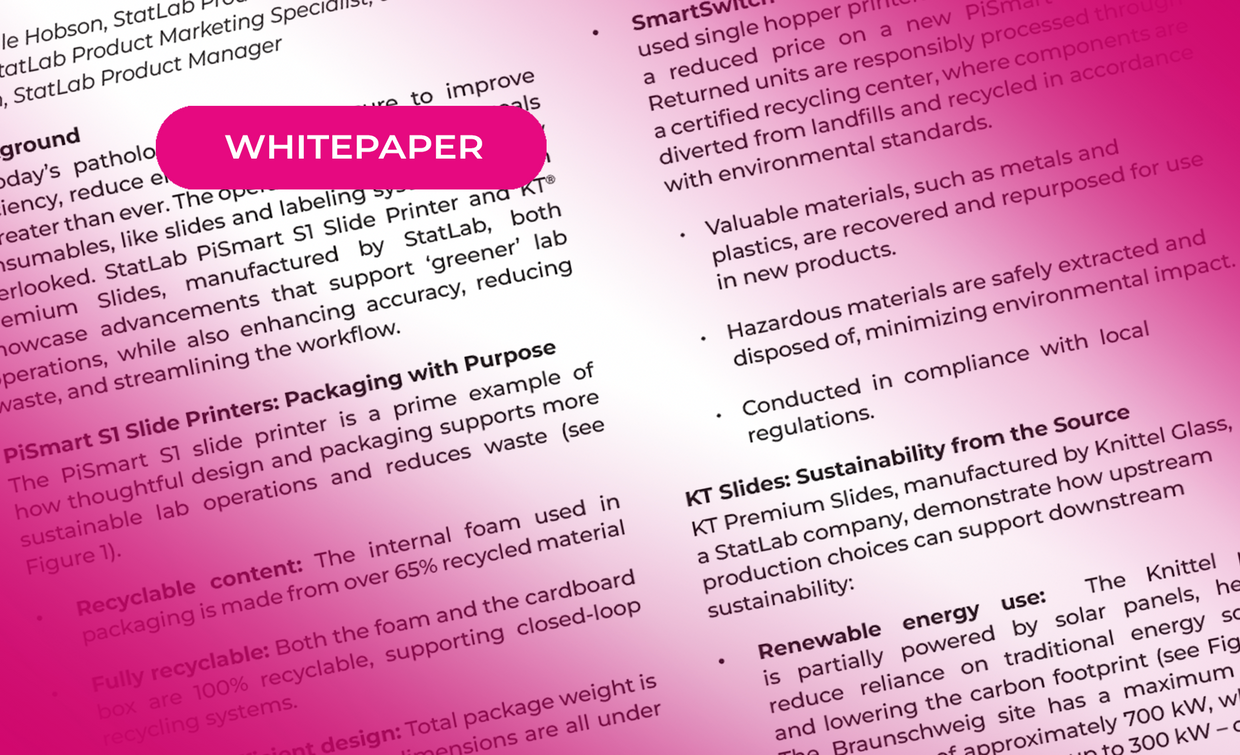
Large format histology allows pathologists to better examine tissue in larger pieces, leading to a faster and more accurate patient diagnosis. But are you processing large format tissue correctly?
How to prepare for processing large format tissue.
In order to achieve optimal high-quality tissue processing, and reduce processing times, the ability to gross tissues consistently to 5mm thickness is crucial. However, due to the countless types and variable consistencies of tissues, this is not always possible.
In order to achieve optimal high-quality tissue processing, and reduce processing times, the ability to gross tissues consistently to 5mm thickness is crucial. However, due to the countless types and variable consistencies of tissues, this is not always possible.
To overcome these challenges, it is often helpful to first gross the tissue into thicker slices before placing them into 100% reagent alcohol or ethanol for an hour in order to stabilize the tissue. This treatment not only firms the tissue to allow thinner slices to be taken but often reduces the need for reprocessing fatty or other problematic tissue. If tissues contain large amounts of fat, placing them into a fat solvent such as acetone is advantageous before attempting to gross the tissue into thinner 5mm slices. In addition, using isopropanol as the dehydrating agent during processing of fatty tissue is often recommended as it is a superior fat solvent compared to ethanol.
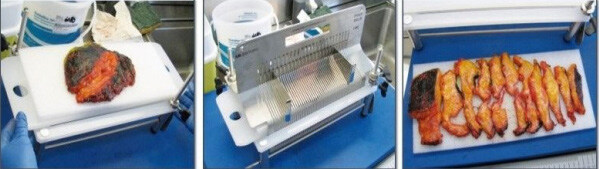
However, if reagent alcohol is your preferred choice as a dehydrating agent, then extending processing times in that reagent would be required to ensure optimal processing. Since minimizing the thickness of slices is essential for quality processing of large tissue samples, commercial aids are available for the consistent grossing of tissue. Systems such as the ProCUT slicing devices (Milestone Medical) and the TruSlice specimen cut up systems (CellPath) are not only convenient to use but also allow reliable production of thin slices of fresh and fixed tissues in the grossing room (Figures 1 & 2).
Figure 1.
The ProCUT grossing system from Milestone Medical showing the tissue on the base prior to grossing (left), application of a dome large enough to accommodate the tissue (center) and the tissue following grossing (right).
The ProCUT grossing system from Milestone Medical showing the tissue on the base prior to grossing (left), application of a dome large enough to accommodate the tissue (center) and the tissue following grossing (right).
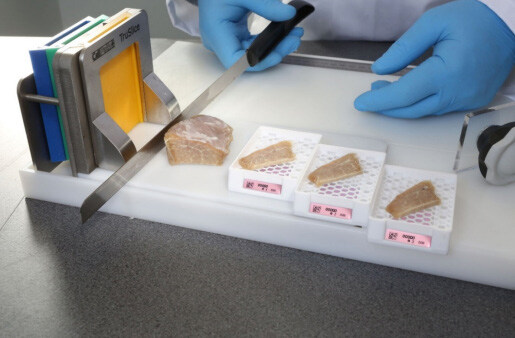
Figure 2.
The TruSlice grossing system from CellPath shows a sharp blade used for slicing the tissue and Supa Mega Mothership cassettes containing selected samples.
The TruSlice grossing system from CellPath shows a sharp blade used for slicing the tissue and Supa Mega Mothership cassettes containing selected samples.
Are you using the right cassette?
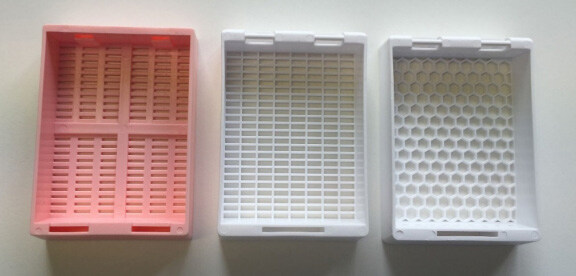
In large format histology, the choice of cassette plays a significant role in tissue processing and several types are available in the marketplace (Figure 3). Although the large format, Supa Mega cassettes have an external measurement of 75x52mm, they have an internal depth that varies between 6mm and 15mm depending on the cassette type (Figure 4). Open pore areas of the cassettes also play a central role in the processing of large slices of tissue and the latest hexagonal designs have an open pore area of 67% (Figure 5). These larger pore areas increase the flow of reagents, thereby improving diagnostic turnaround by substantially reducing the processing times.
In large format histology, the choice of cassette plays a significant role in tissue processing and several types are available in the marketplace (Figure 3). Although the large format, Supa Mega cassettes have an external measurement of 75x52mm, they have an internal depth that varies between 6mm and 15mm depending on the cassette type (Figure 4). Open pore areas of the cassettes also play a central role in the processing of large slices of tissue and the latest hexagonal designs have an open pore area of 67% (Figure 5). These larger pore areas increase the flow of reagents, thereby improving diagnostic turnaround by substantially reducing the processing times.
Cassettes with a reduced 6mm internal depth such as the Supa Mega mothership or Supa Mega slim cassette are available and help to ensure that tissues are grossed consistently to 5mm thickness. If 15mm deep Supa Mega cassettes are used, thin 5mm tissue slices may be separated by spacers in order to reduce the well depth of the cassette. As a result, tissues remain distortion-free and benefit from consistent, high-quality processing.
All large format cassette types are compatible with most modern automated tissue processors. All routine processors can be adapted for large format cassettes whether the tissue processing schedules employ reagent alcohol (ethanol) and xylene, isopropyl alcohol (with or without xylene) or xylene substitutes. Depending on the type of processor used, a maximum of 32 SM standard or 64 SM slim cassettes can be stacked or layered in the baskets and racks supplied.
Processing times can be adjusted accordingly but will depend upon variables such as tissue type, the final thickness of the tissue slice, the style of cassette employed (standard, mothership or slim) and the method used in loading the cassettes into the processor (stacked or layered). Generally, processing times for tissues 5mm in thickness will be half that of thick slices, with tissues taking roughly 18 hours to process. In practice, processing times of under 8 hours may be achieved for 5mm tissue samples such as prostate using microwave assisted processing.
Figure 3.
Large format cassettes showing the standard Supa Mega cassette (white), Slim (blue) and Mothership styles (yellow). Supa Mega mothership mold with Supa Mega mothership cassette (pink) are in the background.
Large format cassettes showing the standard Supa Mega cassette (white), Slim (blue) and Mothership styles (yellow). Supa Mega mothership mold with Supa Mega mothership cassette (pink) are in the background.
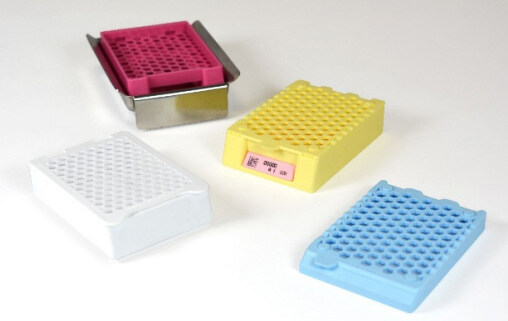
Figure 4.
The image on the left shows the depth of the large format Supa Mega cassette (white) in relation to the reduced depth of the Supa Mega slim cassette (blue). The image on the right shows the Supa Mega mothership cassette (yellow) with the same external but shallower internal dimensions as the conventional large format cassette (white).
The image on the left shows the depth of the large format Supa Mega cassette (white) in relation to the reduced depth of the Supa Mega slim cassette (blue). The image on the right shows the Supa Mega mothership cassette (yellow) with the same external but shallower internal dimensions as the conventional large format cassette (white).
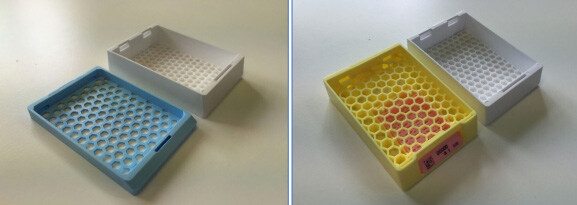

Figure 5.
Large format cassette types showing (from left to right), the traditional (pink), the latest slotted (centre) and the hexagonal open pore area designs (white).
Large format cassette types showing (from left to right), the traditional (pink), the latest slotted (centre) and the hexagonal open pore area designs (white).
Recent Posts
-

KT Slides & Background Staining
Background Whole slide imaging (WSI) is gaining widespread adoption in diagnostic and research path
-

Happy National Histotechnology Professionals Day!
Thank you for the vital role you play in providing the best possible patient care. We see your hard
-

Why HCA Mid-America Division only uses KT slides in their lab.
One lab's story of overcoming tissue wash challenges.