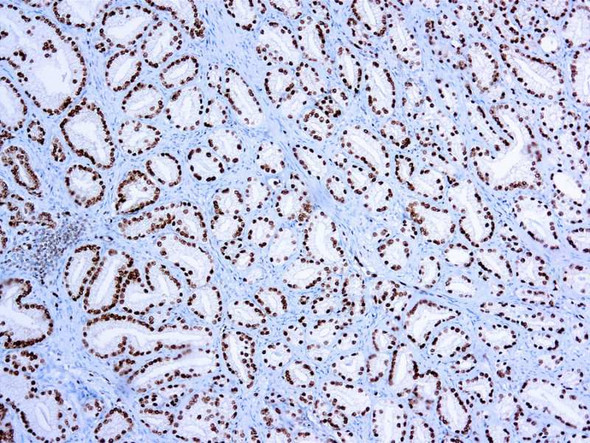


Description
Mouse Monoclonal. Ready-to-use. Intended for in vitro diagnostic (IVD) use. Anti-p53 tumor suppressor protein antibody recognizes a 53 kDa phosphoprotein, identified as a p53 suppressor gene product. It reacts with the mutant as well as wild typep53. Positive nuclear staining with this antibody has been shown to be a factor in breast carcinoma, lung carcinoma, colorectal carcinoma, urothelial carcinoma, and ependymoma. Anti-p53 positivity has also been used to differentiate uterine serous carcinoma from endometrioid carcinoma, as well as a marker for intratubular germ cell neoplasia. References 1. Dabbs DJ. Diagnositc Immunohistochemistry. Third Edition. Saunders. 2006. 2. Mayall FG, et al. P-53 immunostaining in the distinction between benign and malignant mesothelial proliferations using formalin-fixed paraffin sections. J Pathol. 1992; 168:377-81. 3. Caffo O, et al. Prognostic value of p21(WAF1) and p53 expression in breast carcinoma: an immunohistochemical study in 261 patients with long-term follow-up. Clin Cancer Res.1996; 2:1591-9. 4. Bebenek M, et al. Prospective studies of p53 and c-erbB-2 expression in relation to clinicopathological parameters of human ductal breast cancer in the second stage of clinical advancement. Anticancer Res. 1998; 18:619-23. 5. Midulla C, et al. Immunohistochemical expression of p53, nm23-HI, Ki67 and DNA ploidy:correlation with lymph node status and other clinical pathologic parameters in breast cancer. Anticancer Res. 1999; 19:4033-7. 6. Van den Berg FM, et al. Detection of p-53 overexpression in routinely paraffin-embedded tissue of human carcinomas using a novel target unmasking fluid. Am J Pathol. 1993;142:381-5. 7. Zen ZS, et al. p53 nuclear overexpression: an independent predictor of survival in lymph node--positive colorectal cancer patients. J Clin Oncol. 1994; 12:2043-50. 8. Korshunov A, et al. Immunohistochemical markers for intracranial ependymoma recurrence. An analysis of 88 cases. J Neurol Sci. 2000; 177:72-82.
Storage
Refrigerated Storage
Store refrigerated at 2°C to 8°C (36°F to 46°F)
Refrigerated storage upon delivery is important for correct product functionality.